Story by TMC Editor / March 15, 2018
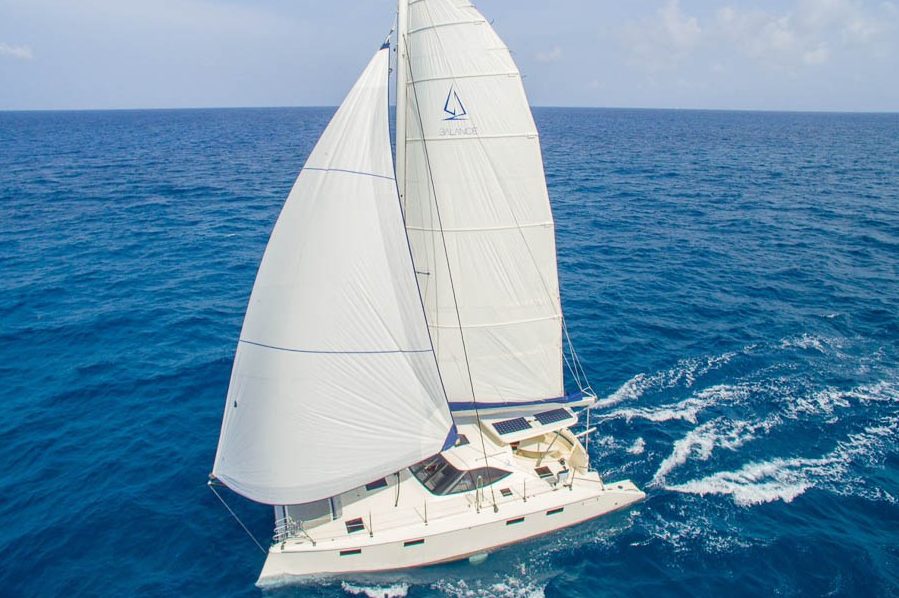
We have just arrived in George Town, Great Exuma Island. The Bahamas are famous for turquoise, shallow or “skinny” waters, so we’re grateful for our catamaran with it’s 4 ft draft. Amazingly, we have been buddy boating with another sailing family from Steamboat – Sarah, Chris, Spencer and Will. Their boat, is a traditional monohull with a keel that extends 6 feet below the waters surface. They are much more cautious about their routes than we need to be.
Twenty years ago when we bought our first catamaran, people thought that we were crazy for not buying a traditional sailboat. Now we are seeing as many catamarans as we are monohulls. Dean’s description below explains our reasons for choosing a catamaran…twice.
In October, 2002, the Snowcat crew (ie- Dean, Karen and the kids) were sitting at the dock in Las Palmas, in the Canary Islands, making our final preparations to cross the Atlantic Ocean as a part of the Atlantic Rally for Cruisers (“ARC” 2002”). Our boat, Snowcat, was a Catana 431, a cruising catamaran designed for blue water cruising. While we’d completed several multi-day voyages, including a 6-day passage from Gibraltar to the Canaries, the Atlantic crossing was going to be a huge step for us, and we’d spent several weeks getting the boat, our provisions and honestly, ourselves, ready.
A few nights before the scheduled departure we invited several families with kids over for a bit of a departure party and inevitably (unfortunately) the age old “cat vs monohull” debate broke out in a rather unfortunate way. Upon arriving aboard with his family, a British “gentleman” who owned a beautiful Oyster forty-something yacht, derisively said “Are you really going to take your family across the Atlantic on this?”. The cockpit went silent waiting for the argument to break out, but I simply defused it by saying “Yeah, and we’ll probably beat you across”. The party revved back up and moved on to more pleasant topics, including a concert from all of the kids and their various instruments who’d packed aboard our boat that evening.
I love catamarans as a cruising platform for a million reasons. Having been born in Wyoming and raised all around the US, always at least a thousand miles form the nearest ocean, I had no deeply ingrained nautical heritage. I learned to sail on a wind surfer, finally graduating to a Catalina 22 monohull which I could trailer around lakes in Colorado and once to the Nebraska ocean (lake McConaughy). Karen and I were engaged aboard a chartered monohull in the San Juan islands, and honed our ocean sailing skills aboard various monohull charters in the Caribbean and Society Islands. But, when we decided to cut loose and cruise with our family for what turned out to be 4 years and 15,000 miles, our analysis quickly turned to catamarans, and we’ve never regretted it. We chose the Catana 431 at that time because of its proven bluewater capabilities, and, perhaps more importantly, a temporary currency revaluation which allowed us to afford it.
From a live-aboard perspective, the benefits of a catamaran are somewhat obvious.
The infuriating British Captain’s question was probably related to his (mis)perception of a catamaran’s safety at sea. I’ve never been able to get a completely rational discussion of this “issue” which is not confused with nautical heritage. That said, the most common argument is that cats flip over, and don’t “right” themselves like a monohull. While some early cat designs did have a propensity to flip, those days are long gone and modern cruising cat designs have evolved to a very high level of safety.
Extreme conditions such as hurricane force winds and microbursts do pose risk of capsize, as they would in any boat. I’m one who believes all boats should be sailed conservatively – monohulls as well as catamarans – and that’s what we do, period. In a cat, you do not reef your sails based on the degree of heel or “feel”, rather, we have very specific apparent wind speed when we reef (18 kts for the 1st reef, 22 kts for the 2nd) sooner than that if seas are rough, and we always put the first reef in at sunset on the overnight portion of any passage. Reefing conservatively may lead to a slight reduction in speed over ground, but it’s more that worth it in terms of overall comfort. We also carry a Para-tech sea anchor set up which would allow us to simply shut down and take a rest if the conditions get too crazy. (We’ve never had to use it in either boat, after what’s now approaching 20,000 miles at sea)
And finally, cats are just faster. Upwind on a tack, with our dagger boards down we’ll hold our own with most comparable monohulls, and as soon as the wind goes anywhere near the beam, we’re gone from sight pretty quickly. Speeds in excess of 10 knots, in moderate winds are pretty common and we comfortably hit 15kts with sails double reefed when we crossed the Atlantic.
So, Karen and I both love the traditional look of a beautiful old Hinkley monohull, but give us a cat any day. And, by the way, what happened with Captain Oyster? Well, we ended up crossing the Atlantic in 16 days making landfall in Tobago. We spent a couple of days there, sailed to Trinidad to haul the boat and fly home to Colorado for Christmas. Captain Oyster was still sloggin’ his way across the Atlantic. Finally after 24 days he arrived on the other side, having lost his dinghy and davits in the process. For us, monohulls are “half a boat”- catamarans are the best for cruising.
This article was published with permissions by Dean and Karen. Their original blog post can be found here.
We had an outstanding experience working with Andrew Hodgdon to find our dream boat, an Outremer 52.
We were actually referred to him by several different people—clients who had been very happy working with him, as well as boat owners who were planning to use him to sell their own boats. After working with Andrew ourselves, we completely understand why he came so highly recommended.
We worked with him for several months, and from start to finish, he was exceptional. Andrew is incredibly knowledgeable and truly an expert when it comes to performance catamarans. He took the time to understand exactly what we were looking for, was always responsive and organized, and never made us feel pressured throughout the process.
Andrew went above and beyond to arrange showings for us in multiple states and even traveled to another state to be there with us for the sea trial. His expertise and guidance gave us tremendous confidence as we evaluated such a significant purchase.
The entire process could have been overwhelming, but he made it remarkably smooth. He was on top of every detail and made the paperwork and closing process easy, working seamlessly with his team at The Multihull Company.
What impressed us most was that he genuinely had our best interests in mind. And his support didn’t end when the sale was completed. He has continued to stay in touch and has made it clear that he is still available to help us if we ever need him. That kind of follow-through is rare and speaks volumes about the kind of broker he is.
Buying an Outremer 52 was a huge decision and a major investment, and having someone with his knowledge, experience, responsiveness, and integrity made the entire experience so much easier and more enjoyable.
We couldn’t recommend Andrew Hodgdon more highly. If you’re looking for a yacht broker—especially if you’re considering a performance catamaran—we would choose him again without hesitation. The fact that so many people recommended him to us was the reason we called him, and after working with him, we would be one of those people recommending him to others.
I highly recommend Andrew Hodgdon. He served as our buyers broker. He is responsive, highly knowledgeable and very experienced. He is also an excellent guide and counselor before, during and after the boat purchase process. If you are looking for a good-sailing cat, he seems to collect most of the available boats on the better-sailing side of the market. Top marks.
Andrew did an excellent job getting me started on my new adventures. Worked with my conflicting schedule. Is very knowledgeable in the catamaran industry. 😎
I recently sold my Lagoon 450 with the Multihull Team. I would highly recommend their services. The professionalism and personal treatment I received was greatly appreciated.
Great Service, Great People
Helped me through the process.
I would go through them again in a future purchase.
Successful relationships cannot exist without it. At The Multihull Company we base every relationship on a firm commitment to earning and retaining our client’s trust.
Advice of any kind is valuable only when grounded in hard-won expertise. It too, must be trustworthy. Trust and expertise define the heart and soul of The Multihull Company. We are a team of skilled professionals who thrive on providing expert, trustworthy advice and service to catamaran and trimaran sailors around the globe.
More About Multihull